Showing posts with label diversity. Show all posts

Monday, August 24, 2009

Diverse book recommendations

Toward Community: Unity in Diversity held their annual Celebrate Diversity picnic on Aug. 16, 2009. Attendees were asked to write down their favorite books. Though only a minority of folks participated, they came up with an interesting list that reveals diverse ages, backgrounds, and literary tastes. Thanks to Toward Community board chair Kamal Varma for compiling and sharing.

Thursday, July 16, 2009

This really frosts my cake...

The online forums in the Post-Crescent (or any online forum, generally) are not always the place for reasoned debate. In particular, the anonymity of the great majority of those who post using "handles" makes it possible for people to say anything without attaching their names to it --and thus taking responsibility for their statements.

I'll let a lot of the things I read there roll off. I'll usually post -- using my name, natch -- if I feel there are some facts lacking that can be readily supplied. Sometimes I just have to take issue, which is the case when I read statements that appear prejudicial. There were two today:

PSY-OPS wrote:
"yuppy [condo] tennants probably wouldn't like mingling with the library's current daytime clientele."
helpusnow wrote:
"food, clothing and shelter are needs-libraries are wants; because poor people"want" a place to hangout i dont feel a "need" to pay for it"
Without even getting into whether education, culture, opportunity and hope are needs (and they are), I felt obligated to speak out on behalf of both poor people and all library users, and posted the following:
There are those who legitimately disagree whether this is a worthwhile project. But it is difficult to accept minimizing the need by belittling those in the community who may be poor or homeless. Yes, the poor, the homeless, the disabled, and the mentally ill use the library.

Many other people use the library in even larger numbers. There are lots of toddlers and babies here every day -- and doctors, housewives, teenagers, senior citizens, judges, business people, students, & mostly just plain folks. It's a place for everyone.

We've had 8,602 people through the doors in the last three-and-a-half days. With this volume of use, this many people, there are occasional problems & all are not solved instantly. But staff and volunteers do a good job of enforcing the basic common sense rule: keep it nice for everybody.

It's a lousy argument to say the library includes people to look down on & thus is unworthy of support.

Terry Dawson

Friday, June 19, 2009

The Community Library

I worked for seven years in academic libraries and found it worthwhile and fulfilling on many levels. There was a focus on formal learning and research, knowledge in depth, extensive research tools, and a community of scholars. But it wasn't quite my niche. I was looking for something broader, more encompassing and inclusive. I found it at the Appleton Public Library.

I love the fact that this is a place that welcomes all ages and income levels. e only criteria for using the public library are wanting to be here and civil behavior. We've made it easy because we need to be inclusive. We get the babies and the senior citizens. We get the able, the disabled, the well and the ill. We get the doctors, the judges, the preachers, and the homeless. We get the readers and the watchers, those who walk, and those in strollers or wheelchairs. We serve the nonprofit organizations, the business community, and the unemployed. We welcome everyone to a place which is, if not a community of scholars, nonetheless a community of learning, culture, and communication.

Communities and people need public libraries: places to read, talk, go to a 4-H meeting, a puppet show, or a discussion series on the Revolutionary War. Some of us may do research and social networking on home computers, but we need to physically gather with other humans, to ask questions, explore ideas, discuss and learn. We need to find what we’re looking for, but also to be surprised by all the things that are here and all the things others bring. In a democratic society, it’s vital that we create opportunities for everyone to learn – as each person determines their own wants and needs. And people need books, and will for years to come.

We need to be part of a diverse community, to offer and be part of equal opportunity, to seek the challenges of diverse people and different points of view.

Naysayers -- or those neither curious nor community-minded -- may say the day of the library, especially the public library, is past. Those who are paying attention, those who are engaged in making better lives and learning opportunities for themselves and all their neighbors, and the increasing numbers who use us, know better. That’s why U.S. News & World Report picked “librarian” as one of the top careers for 2009, saying “librarians are among our society's most empowering people.” We’re present – and we have a bright future.

Welcome to your public library. We’ll work to keep it welcoming for everyone.


from the Fine Print newsletter, Summer 2009

Friday, February 27, 2009

Diversity: What is Your Comfort Level?

I'm excited that next Saturday, March 7, Appleton will host a Diversity Conference. Our library will be a participant at the event, held at Appleton North High School and sponsored by the Fox Cities Rotary Multicultural Center -- of which the library is a member.

I have long felt that public libraries have a natural affinity for diversity efforts. Inclusiveness and opportunity for the entire community are part of our core values, and our continuing focus on intellectual freedom means we are bound to seek out and include all points of view. So I'm glad we'll be participating in this conference, which "is to provide ideas, resources and inspiration to educators and community members to make a difference", with a focus on
  • Enhancing a Multicultural Learning Environment
  • Eliminating the Achievement Gap
  • Fostering Social Justice/Activism
  • Promoting Multicultural Education in the 21st Century
Sessions will include, among others:
  • Eliminating the Achievement (Opportunity) Gap through Multicultural Education: Shifts of Consciousness and Practice
  • Societal Trends Affecting Education
  • Mental Health Issues in the Classroom and the Community
  • Integrating Multicultural Literature Into Curriculum: A Space and Place For All
  • Closing the Knowledge Gap is a key to Eliminating the Achievement Gap
  • Honoring our Common Differences: Creating Inclusive Classroom or Workplaces
  • Disparities in Poverty and Race: Closing the Achievement Gap
  • Promoting an Inclusive Environment for Lesbians, Gays, Bisexuals, and Transgender Individuals in our Schools, Workplace, and Community
  • Diversity Resources at the Appleton Public Library
  • Lawrence University ArtsBridge: A Successful Model for Integrating the Arts with the Contemporary World Studies Curriculum
  • Our Impoverished Notions of Poverty: Toward an Authentic Understanding of Education and Class
  • Community Dialogue on Unity and Diversity
I'm glad our community is intentional about this conversation and look forward to the increased awareness that will result. I'm proud we can be a small part of it. Get a brochure for the event here.

Thursday, January 1, 2009

DC libraries waken controversy

There's a tough dance between being a good librarian, compassionate, progressive, inclusive in providing service -- and yet tough-minded and aware that we're always making choices about scarce resources.
Proposed Rules Would Ban Sleeping in Library

By Martin Weil and Elissa Silverman
Washington Post Staff Writers
Monday, December 29, 2008; Page B03

New rules have been proposed for D.C. public libraries, including a ban on sleeping and a limit on bringing in bags, in what library officials called an effort to make the system more welcoming. [full story]

The coverage is in the Washington Post, but the more interesting story is in the online comments posted, which constitute a fascinating debate about the role of libraries and the problems of homelessness. Seems to be a polarizing issue.

Our approach to date at APL has been to evaluate situations on the extent to which they cause a problem and interfere with library use. The occasional (non-snoring) sleeper has not been a problem, someone passed out in a chair in an alcoholic haze with a booze bottle in his pocket is a problem. If all our chairs were occupied by sleepers it would be different, but where's the line? It's tempting to be black & white: "sleeping is forbidden!", but for now that seems more unjust -- if simpler -- than the more difficult gray of judgement calls.

Friday, September 12, 2008

Diversity @ the Library

Public libraries have an obligation to serve the entire community and to present a broad variety of viewpoints. This makes us naturals for supporting diversity. We're not exclusively a children's library, a men's library, a Christians' library, a straight library or a white library. We're not exclusively a Muslim's library, a women's library, a teen library or a library for people with disabilities. We're all of those and more. We're everyone's library; our resources and services reflect it.

Our local paper, the Post-Crescent, ran a story a few weeks ago: "Valley getting more diverse," and it's true. While the article focused on the growing Hispanic population, we have grown more ethnically diverse in lots of ways. Some would say we had a lot of catching up to do: though there's no evidence there was ever an actual ordinance to the effect, Appleton had reputedly once been a "sundown town" where African Americans could not spend the night. Thankfully, that's changed!

In addition to visible and active African American and Hispanic populations, Appleton is blessed with a thriving Hmong community. This morning, Jennifer Gaines Bates of the Hmong American Partnership addressed our staff and we had a good discussion about Hmong culture and traditions and how we might better serve this population. One thing we've done recently is to establish a Hmong Resource Center collection, including all our materials in the Hmong language or about the Hmong culture.

Hispanic culture and collections being larger and more diverse, we can't so easily pull together all the Spanish language materials or everything about Spain and Latin America. But we're working to develop those collections and make them easier to access. Our online catalog has a Spanish language version. We're also exploring issues: last night we hosted a spirited discussion of immigration issues following a showing of the film Crossing Arizona, an award-winning documentary about illegal border crossings.

In a couple of weeks, we'll be hosting the Consulate General of Mexico for a few days, as they work to make updated visas and other identification available to Mexican citizens. Our Mayor's office has arranged this for the second year in a row and we'll have volunteers from local Latino groups helping. And we join many other libraries in recognizing National Hispanic Heritage Month, Sept. 15-Oct. 15.

Our community is blessed not only with a great variety of ethnic populations, but with organizations that support diversity. Our library is a longstanding member of Toward Community: Unity in Diversity and the Fox Cities Rotary Multicultural Center. Library staff attends meetings of inter-agency coordinating councils serving local Hmong and Hispanic communities. We've done some multilingual story hours and we're planning more. It's exciting to see how diversity has enriched our community and library.

Friday, July 18, 2008

“Welcome Stranger” - immigrant outreach

Earlier this year, the Urban Libraries Council published a look at public library strategies that help communities successfully welcome New Americans. "Welcome, Stranger: Public Libraries Build the Global Village" is a guide to finding the areas in which libraries can make a difference and identifying programs that turn ideas into action."

I can compare some of our current local activities, even while looking for opportunities:
  • Our library is a member of a local diversity organization, Toward Community, which is holding its annual "Celebrate Diversity" picnic this Sunday. One of the organizers just checked out CDs from the library's collection of world music to play at the picnic. The library & TC have done many joint programs.
  • APL is also active in the Fox Cities Rotary Multicultural Center, which on August 23 will hold their annual fundraiser, "Foods of All Nations" on downtown streets near the library. Contact us if you want tickets!
  • For the second consecutive year, our library will host a local visit by the Consulate General of Mexico, which will help Mexican citizens renew their official papers without traveling hundreds of miles. The visit, planned in conjunction with our Mayor's office and local Hispanic organizations, will be Oct. 2-5.
  • We did some innovative work providing the Prime Time Family Reading program for emergent readers and families in a multilingual format
  • We have developed, and are close to unveiling, our Hmong Resource Center collection. Our staff, working in concert with the local Hmong community, has been doing a great job.
The ULC work "Welcome, Stranger" identifies five strategies for successful immigrant inclusion and community adaptation, including
  1. Understand Local Immigration Dynamics
  2. Bring Sensitivity to Service Delivery (effective promotion using first languages of immigrants)
  3. Build English Capacity
  4. Create Connections to Local Institutions
  5. Encourage Civic Engagement
The ULC website says:
Authors Rick J. Ashton and Danielle Patrick Milam, both of ULC, note, "Using their historic role as strong, unbiased public spaces, dedicated to learning and exploration, they [libraries] are fostering public discussion of the challenges faced by both newcomers and the communities receiving them."
and quotes ULC President Martin Gómez:
"It's clear that the public library has an important and vital role to play in providing essential library services as well as directing immigrants to resources in their new communities"

Monday, March 24, 2008

Hmong Elders -- Wii bowling

I would not have predicted this one. I know that Wii bowling has been popular with seniors, but our programming staff has not found much interests among the group that comes to the library for adult game days. But somehow we wound up with a visiting group of Hmong elders who came to try Wii bowling. Staff reports those attending enjoyed themselves greatly, and then adjourned upstairs to see our new Hmong Resource Center, currently in development.

Thursday, August 2, 2007

Bienvenidos

When Nicole, the intercultural liaison from our Mayor's office asked me -- on two days notice -- if the public library could host the mobile Mexican consulate for four days this month, issuing passports and ID to Mexican citizens, I had to think about it. But not for long.

The meeting room was available. My only real concern was that they needed the building during hours when we would normally be closed, and we would need to make sure the library was secure, and that we would be able to maintain restrooms, etc. It turned out that with two exempt employees volunteering to work extra time, it would be feasible to pull it off, so it only took me a couple of hours to say "yes."

Making the Library available was my decision and I'm glad to take responsibility for it. I had only a flicker of reality checking and asking myself if this is the right thing to do. Our mission statement says in part that the "...library is a center of community life, offering opportunities for people ... to gather...". Our long range plan says we're a community gathering place and we:
  • Provide programs and services relating to local history and cultural diversity.
  • Work cooperatively with other local organizations to strengthen the community.
This quite obviously fit the bill for me. We have a lot of precedent for stretching our meeting room availability for other governmental entities. And we were very pleased to have the Mexican consulate choosing Appleton, not only as a service to Mexican residents of Appleton, but because our city is a regional resource.

Some people in the community have been unhappy that some of those who used the services of the consulate were illegally in this country. I understand the concern: in a government of laws, to sanction systematic flouting of those laws will create problems. At the same time, these problems are bigger one our library or city. The President and Congress can't quite figure it out, so I didn't expect that we would.

But if some of those who came to use the services of the consulate were illegal, many were not. Some were actually referred by the US Immigration Service as part of their citizenship process. Others were legal residents who simply needed to renew passports. In any event, whether legal or illegal, our police, banks and hospitals -- as well as libraries -- like it when people can present valid identification. The consulate staff expressed concern about validating and documenting anything they issued -- people who did not qualify were turned away. I don't know if any given person who came to our doors was legal or illegal. I do know they were all people.

In the end it was a great experience. Dozens of community volunteers from churches, schools and support groups were there, doing a great job to facilitate communications and help the staff. While there were hundreds of people who went through the system in each of the four days, queuing in the middle of the night to get a passport, everyone was extremely well behaved and courteous. The library staff received many thanks, from volunteers and local supporters as well as visitors. We ran through our supply of Spanish language brochures on "how to get a library card."

There was no time to take this decision to the Library Board, but I will recommend that if the Consulate wants to come back next year, we welcome them. We've learned a few things about bilingual signage; with more advance notice, it will be easier.

Friday, April 13, 2007

Diversity semantics & logic

Editor, the Post-Crescent:

I am writing in response to the letter from Jim Dickson published in the April 3 Post-Crescent. Mr. Dickson asserts that "One of the latest deceptions to be introduced as politically correct is the concept that diversity is good." He then postulates a series of unethical and criminal behaviors as evidence that diversity can be bad.

Merriam-Webster defines "diversity" as "the inclusion of diverse people (as people of different races or cultures) in a group or organization." I know of no advocates who use the label of "diversity" to include unethical, criminal or harmful behavior. Rather we talk about the spectrum of human diversity to include all types of people -- not all types of behavior. There is still a sad lack of acceptance, in our community and in the world, for different cultures, races, ethnicities, genders, sexualities and faiths. Hurtful, unethical, unkind and criminal behaviors are not examples of "diversity" to lift up, but anti-social behaviors to discourage and censure.

To label anti-social behavior as diversity and then label diversity as "deceptive and dangerous" is to knock down a straw man. Let's not use semantics to justify prejudicial behaviors in a world that needs to do a better job of embracing diversity. This is not mere political correctness. People may not be equal at creation, but we should afford all people equal dignity, and appreciate the richness that diversity brings our community.

Terry Dawson, Chair
Toward Community: Unity in Diversity
Appleton


Post-Crescent, April 3, 2007 letters:

Reflexively praising diversity not smart

One of the latest deceptions to be introduced as politically correct is the concept that diversity is good. Diversity may be good but it may be bad.

Something is not good just because it is different, and putting the label "diversity is good" on a bad habit or improper activity does not make it good.

If diversity is good, what's wrong with smoking in a bar in Appleton? Driving under the influence of alcohol? Taking performance-enhancing drugs? Raping corporate coffers to satisfy a greedy nature? Prowling around for sex partners? Being a bully? Taking a life?

To go from from "all men are created equal" to "diversity is good" involves a step across a huge chasm. People may be equal at creation, but diversity involves a totally different subject: what we do after our creation.Anyone teaching "diversity is good" has a lot of qualifying to do along with their teaching and the qualifying can't be as simple as saying diversity is good "as long as you don't hurt someone else." Diversity may start as an individual activity, e.g., reading pornography, but can end up being a Manson, Gein, Bundy, Dahmer or Gacy.

The teaching that "diversity is good" is deceptive and dangerous. If there needs to be a teaching on our differences, teach that we are created with different abilities and gifts to be used for the good of mankind.

Jim Dickson, Neenah

Monday, March 26, 2007

Diversity letter to UW Law

The Toward Community Board last week directed their chair (yours truly) to send a letter to the UW regarding the situation that occurred as a result of comments by one Professor Kaplan (or at least the way in which his comments were perceived) in a class at UW. While very likely a misunderstanding, whether innocent or insensitive, Hmong students at the UW Law School now feel they are living in a more hostile climate and need to air their differences with the prof. Thye have been unable to get a meeting and the statewide Hmong community is looking for broader support, this the involvement by Toward Community.
March 26, 2007

Dean Kenneth Davis, Jr.
University of Wisconsin Law School
975 Bascom Mall
Madison WI 53706

Dear Dean Davis:

I am writing you on behalf of Toward Community: Unity in Diversity, a grass-roots membership organization in the Fox Cities for the past fourteen years. Our group has consistently spoken out on diversity and justice issues. We are concerned about events in your school that have created some divisive issues respecting Prof. Kaplan and Hmong students.

We encourage you to take a leadership role in facilitating a settlement of these issues. This unfortunate situation can be addressed by intentionally creating opportunities for meaningful dialog. A controlled setting with a mediated discussion can assure that feelings and issues will be explored in ways that seek to reduce, rather than promote, conflict. This situation requires opportunities for healing and closure that such discussion could provide.

We believe there is no inherent conflict between academic freedom and diversity. Indeed, mutual respect and acceptance of diversity are essential for intellectual freedom to flourish. People in Wisconsin look to the UW Law School as an exemplar of justice in our state, and your issues and actions can create statewide ripples.

On our behalf, we hope that you will "encourage that continual and fearless sifting and winnowing by which alone the truth can be found." You have our best wishes and support in seeking an equitable solution that will address the needs of all parties.

Sincerely,

Terry Dawson
Chair, Toward Community: Unity in Diversity
Just as universities need to be sensitive to diversity issues consistent with academic freedom, public libraries need to support diversity in their communities. This isn't a matter of political correctness, it's a matter of sensitivity and mutual support.

Friday, February 23, 2007

Toward Community: statement on Cha Vang

I'm chairing the Toward Community: Unity in Diversity Board of Directors. I'm an individual member, but the library is also a member, as we're also a member of the Multicultural Center. Why is this a library thing?
  • the library is part of the community
  • the library is committed to serving the entire community on an equal basis
  • support for cultural diversity is implicit in the public library ideals of intellectual freedom and fair treatment of all points of view
Looking at the recent and nearby tragic murder of a Hmong hunter in that context ,and with a good deal of input, I drafted the following statement. This was approved by the Toward Community board and sent to the Attorney General, prosecuting District Attorney, media and community groups. The statement itself has nothing particular to do with the library, but I'm not embarrassed to have people think that the library director speaks up for inclusiveness.
Statement on the death of Cha Vang

The Toward Community: Unity in Diversity Board of Directors notes that we are all saddened by any untimely death, and more so by a violent death such as the murder of Cha Vang. As an organization devoted to inclusiveness and diversity in our community, Toward Community has two concerns.

First, there seems to have been a rush to judgment on the part of prosecuting attorneys that Wisconsin’s Hate Crime statutes were not applicable. Given the history of the accused, as well as remarks the accused made to law enforcement, and the vicious violence apparent in the condition of Cha Vang’s body, we are unconvinced that there is no Hate Crime here. We encourage prosecutors to keep this option open through their investigations.

Second, we are concerned about the possibility of blaming the victim, and further blaming the victim’s ethnicity and background. The suggestion that this problem would not have occurred had Cha Vang been proficient in English is unproven. Until all the facts are known, if they ever can be, this is unsupported and could justify further discrimination. Some have suggested that Hmong people not hunt for a year or two, and this is manifestly unfair.

We can insist on better safety training for all hunters. But you can’t legislate courtesy or respect. That takes all of us, and is not furthered by discriminating against all Hmong people by applying additional restrictions.

On behalf of the Toward Community Board of Directors
Terry Dawson, President

Thursday, February 1, 2007

Bittersweet Winds


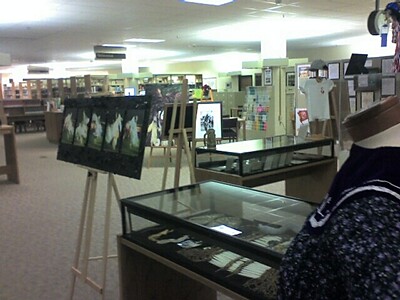
Our library is fortunate to partner with our neighbor, the American Indian Center of the Fox Valley, to host the Bittersweet Winds exhibit.

This is another example of a community partnership I find exciting. Not only are we giving their exhibit a lot of exposure, while they are bringing people into the library and providing us with content, they also held their exhibit opening reception in our meeting rooms. In addition, we host the Indian Center's website on the community network (Fox Cities Online) which the library operates. And it didn't take a whole lot of staff time. This one is hitting on all cylinders for me.

Addendum, Feb. 13: we've received a complaint about the display, stating it is offensive because it decries the use of Native American names as sports mascots. I can understand why Native Americans find this practice offensive. I can understand that there is a point of view stating that no offense was intended, therefore no offense should be taken -- though this strikes me as insensitive. It's harder to understand why someone would be offended by thew statement that other people felt offended. Well, at least we're talking. Except that the complaint was anonymous!